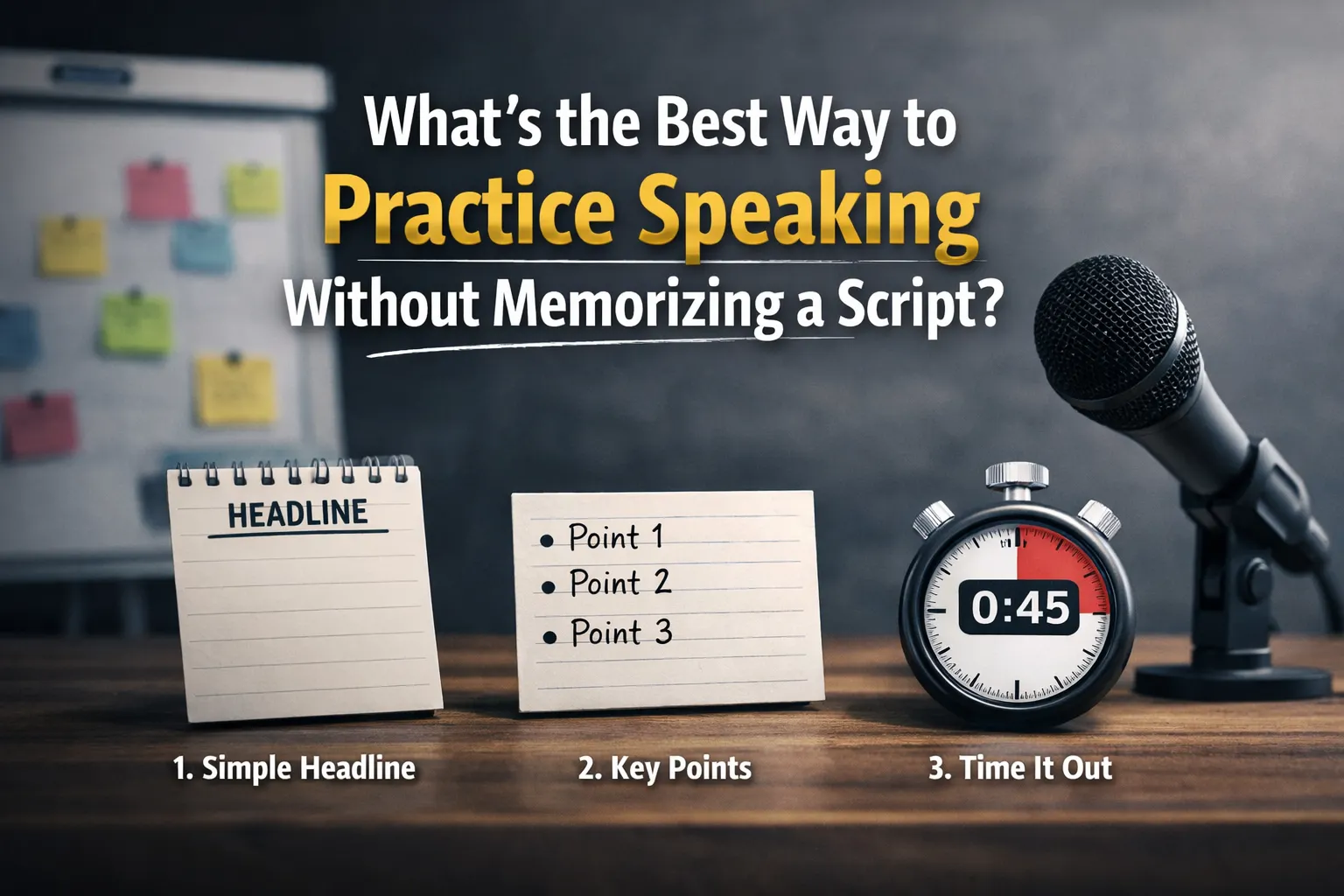
How should a speech be structured so it sounds natural, not rehearsed?
How should a speech be structured so it sounds natural, not rehearsed?
Jan 13, 2026
Most speakers want to sound natural, present, and like themselves.
They don’t want to sound scripted or robotic, like they’re reciting something they memorized at midnight with a coffee and mild panic.
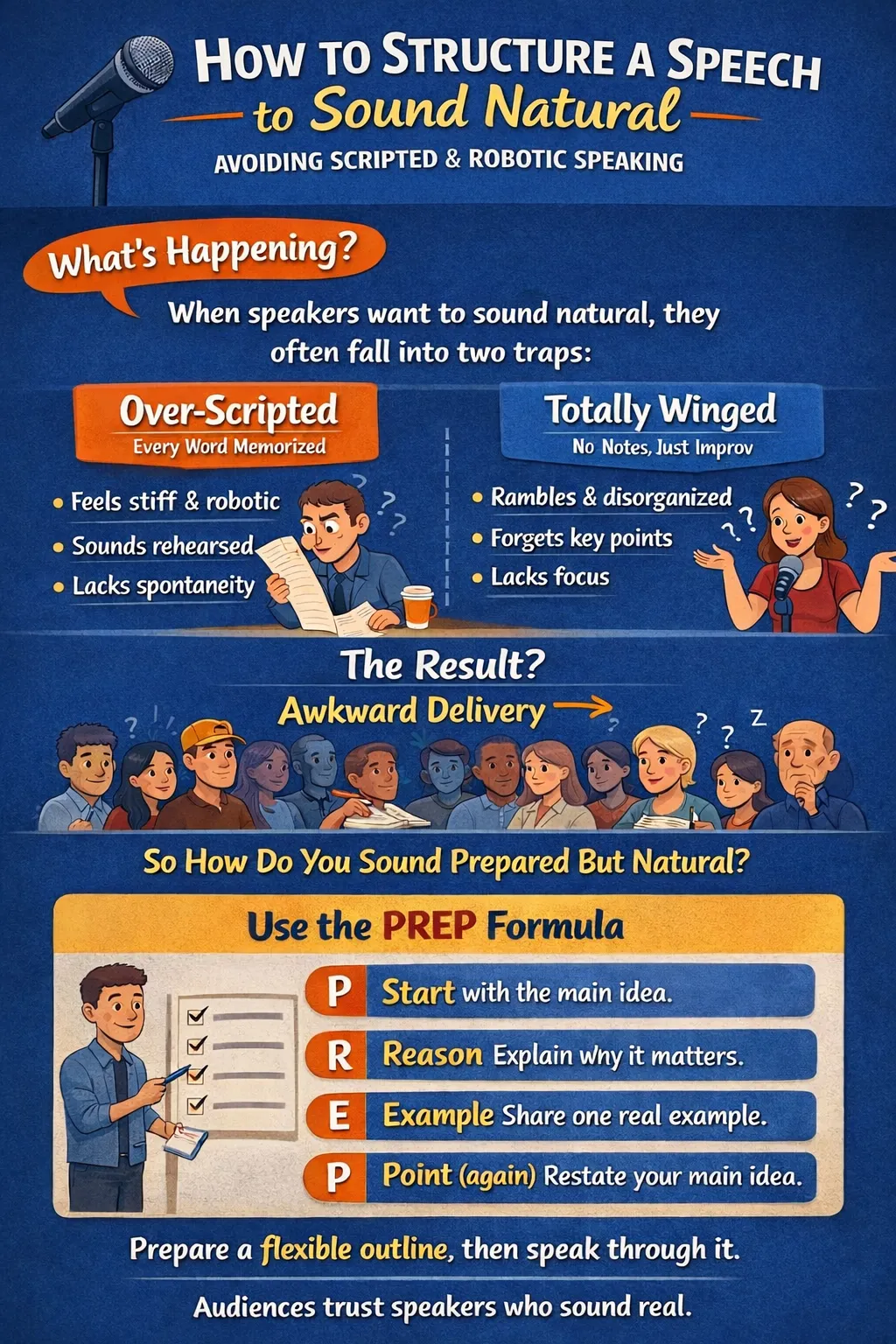
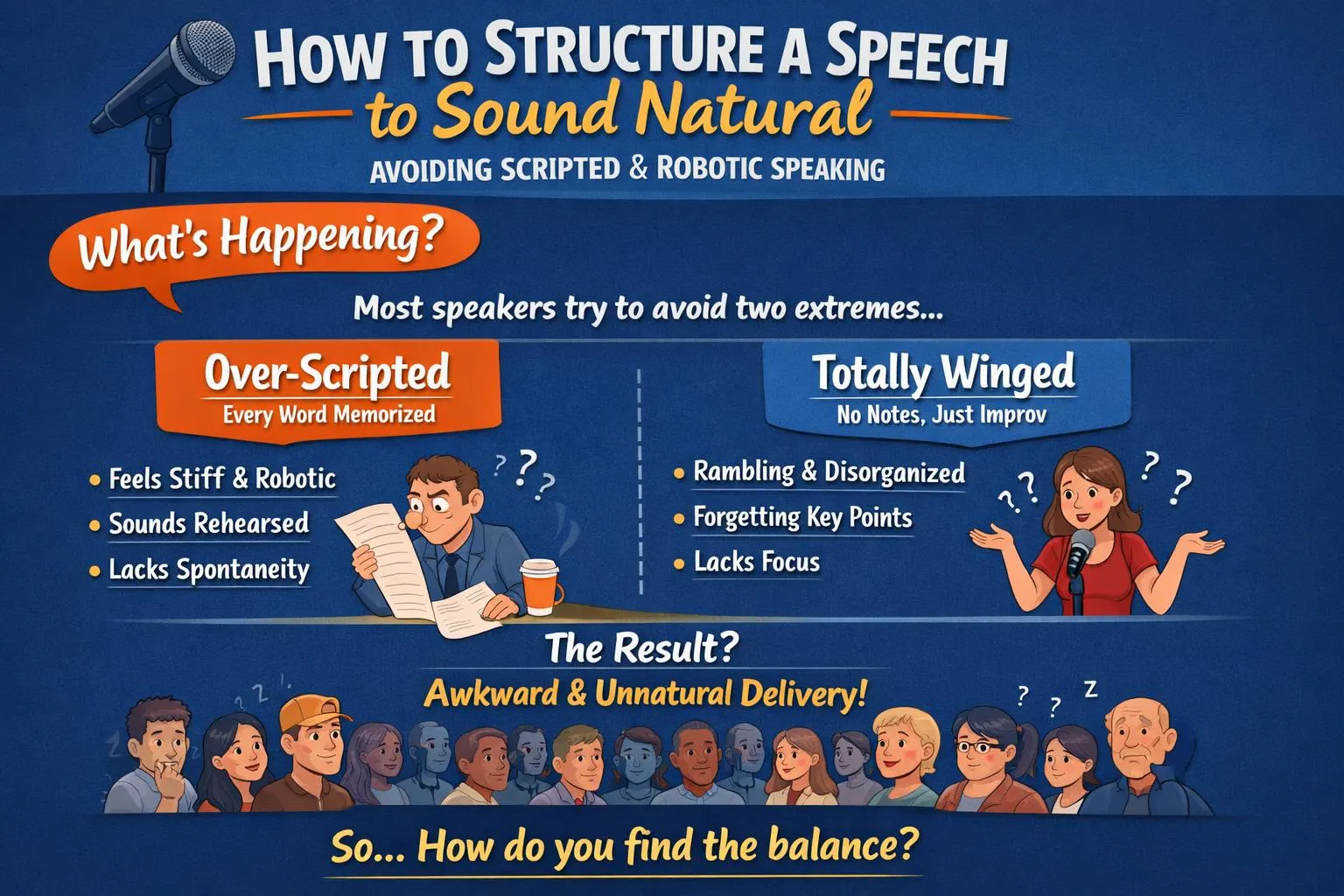
So they usually swing between two extremes.
They either script every sentence and hope it somehow sounds natural anyway.
Or they throw the notes away and “wing it,” hoping authenticity will save them.
It's hard for me to watch.
What’s Happening
When you memorize a speech word for word, your attention turns inward.
Instead of thinking about your idea, your brain starts managing:
- recall of exact wording
- error detection
- self-monitoring (“Did that sound right?”)
This overloads working memory. Cognitive science shows that working memory has limited capacity, and when it’s burdened with precise verbal recall, performance quality drops. Fluency suffers. Natural expression disappears.
That’s why scripted talks often sound stiff or Toastmastery, even when the speaker knows the material deeply.
On the other end, skipping structure entirely creates a different problem.
Without a clear outline, ideas have no direction. You circle, ramble, and lose the thread mid-sentence.
The audience may be polite, but they don't know what you're supposed to say.
Most speakers bounce between over-control and no control at all.
This lack of structure makes speaking feel unnatural.
The Common Misdiagnosis
People usually blame confidence.
“If I were more confident, I wouldn’t sound rehearsed.”
“If I trusted myself more, this would flow.”
"If I just..." they hype themselves up or rehearse harder.
But sounding natural is not a personality trait.
It’s a structural decision.
The Reframe
Natural does not mean unprepared.
Natural means oriented.
The most natural-sounding speakers are not thinking about lines. They’re thinking about the audience:
- How are they responding?
- Where are my critics? I love my critics.
- Who here is going to help me make this experience stick?
Instead of asking, “Did I remember every sentence?” they ask,
“Where are we at and where do we want to go?”
When attention shifts from self-evaluation to contribution, pressure drops.
Research on prosocial motivation shows that focusing on helping others rather than monitoring oneself reduces stress and improves engagement. In speaking, that shift alone can restore fluency.
A Simple Structure That Sounds Natural
Here’s a framework I use constantly because it works under pressure and never sounds rehearsed.
PREP Formula:
Point
What’s the main idea?
Reason
Why does it matter?
Example
What makes it concrete or real?
Point (again)
Restate it so it sticks.
This is not a script. It’s a skeleton.
You don’t memorize sentences. You know where you’re going.
When you practice, you practice moving through ideas, not reciting language. Your wording changes slightly each time, which is exactly what makes it sound human.
What to Do Instead
Point
If you want to sound natural, you need a flexible structure, not a script.
Reason
When you prepare exact wording (like I'm doing with this blog), your attention shifts to recall and self-monitoring. No structure = your ideas drift. A simple framework keeps your thinking organized without locking you into lines.
Example
I always have audiences perform simple exercises. One is to write one clear point, explain why it matters, share one example, restate the point, and move on. Then practice it out without fixing the wording. If you forget a phrase, good. If you reword something, perfect. That’s the skill development.
The truth is, almost every speaker, even in the most amateur audience, puts my examples to shame! (I love it)
Point (again)
You don’t sound natural when you avoid preparation. You sound natural by preparing a flexible framework and letting your thinking speak through it.
AND... if I were speaking, this would be different wording than writing it.
That's the big secret: most people don't speak as we write, and they definitely don't speak how AI writes it. Speaking and writing are similar... but different.
— Devin Bisanz
Related Posts
- Why do confident professionals freeze when they have to speak out loud?
- Is it normal to feel like an imposter when you speak as a leader?
- Why does speaking feel harder as my role gets bigger
- Why do smart professionals feel embarrassed that public speaking is still hard?
For more resources and coaching, visit:
Cited Works
This article draws on research from cognitive science and psychology examining working memory, speech production, and motivation under pressure.
Baddeley, A. (2003). Working memory: Looking back and looking forward.
https://home.csulb.edu/~cwallis/382/readings/482/baddeley.pdf
Levelt, W. J. M. (1989). Speaking: From Intention to Articulation.
https://psycnet.apa.org/record/1989-97544-000
Grant, A. M., & Berry, J. W. (2011). The necessity of others is the mother of invention: Intrinsic and prosocial motivations.
https://selfdeterminationtheory.org/SDT/documents/2011_GrantBerry_AM.pdf