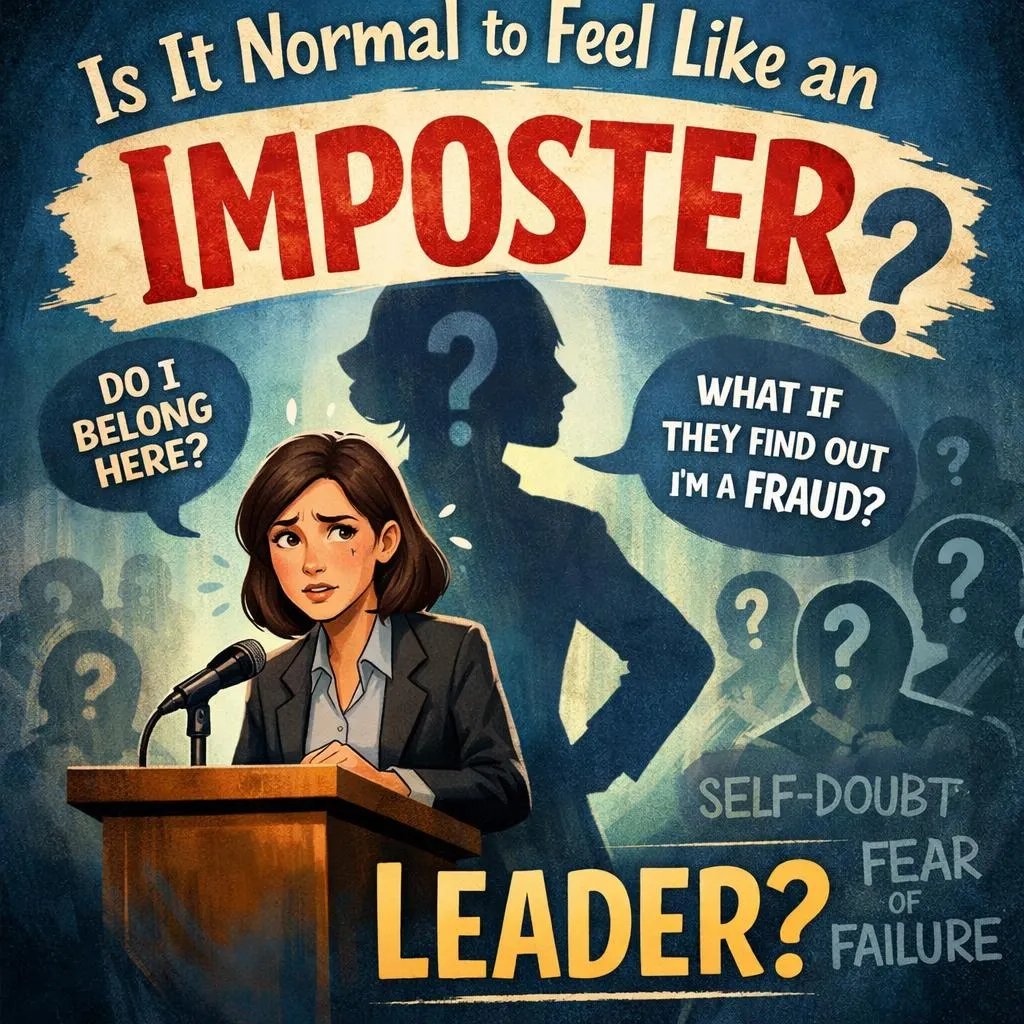
Is It Normal to Feel Like an Imposter When You Speak as a Leader?
Is It Normal to Feel Like an Imposter When You Speak as a Leader?
Jan 12, 2026
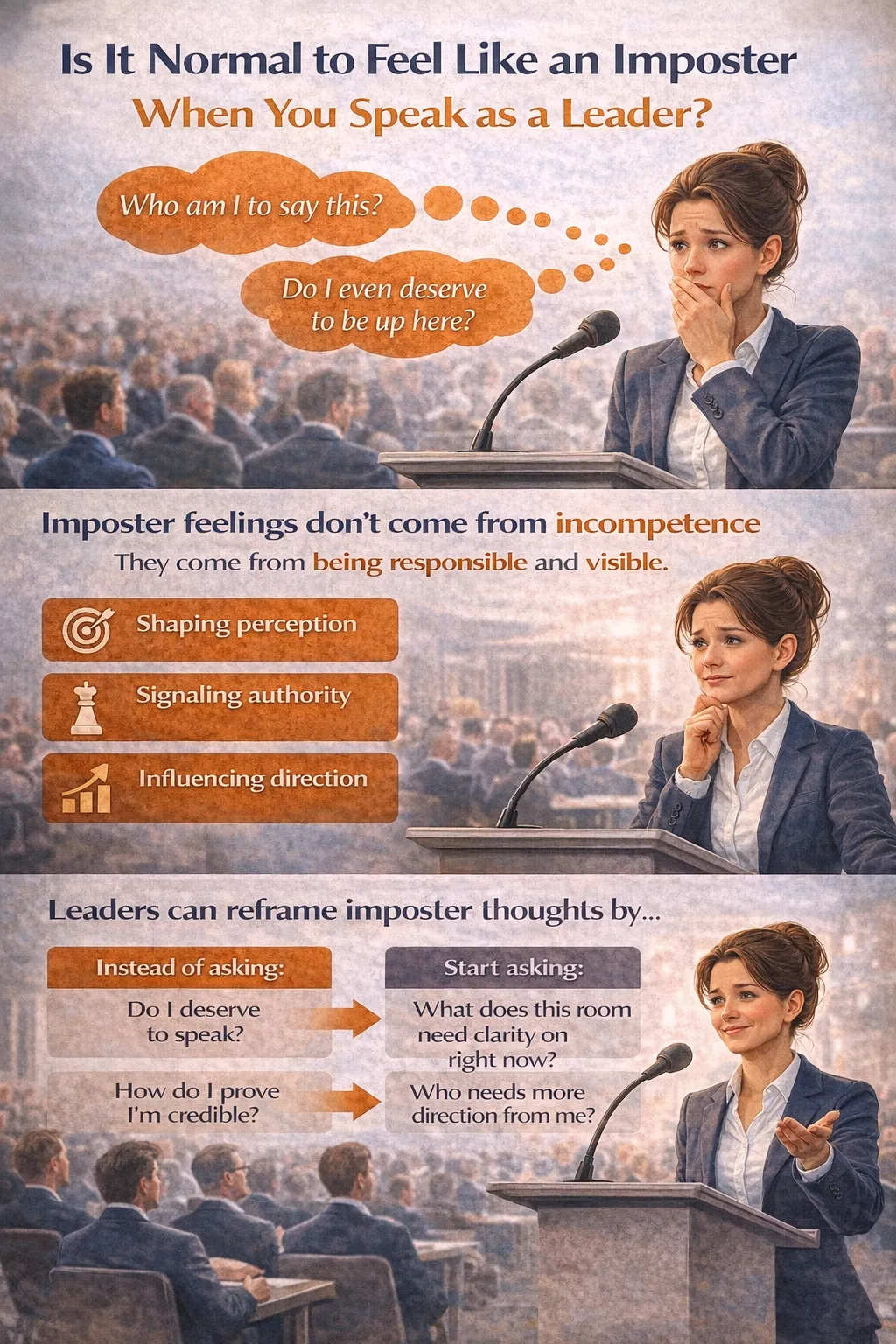
Many professionals carry a silent fear.
Before the moment they open their mouth, a thought flashes through: Who am I to say this?
That feeling shows up at work, in thought, or when making decisions. It does for me!
It also shows up when we have to get into the spotlight and speak.
What’s Happening
Imposter feelings don’t come from a lack of competence.
When you speak as a leader, you’re not just sharing an idea. You’re:
- shaping perception
- influencing direction
- signaling authority
- putting your judgment on display
Your brain treats that visibility as social and reputational risk.
Research on stress under social evaluation shows that when people believe they are being judged by others, cortisol levels increase and self-monitoring intensifies, even when performance ability remains high (Dickerson & Kemeny, 2004).
At the same time, leadership speaking forces you to think and decide in the spotlight. You have to commit.
Some say that the combination activates the part of the brain responsible for threat detection, because status and credibility are on the line.
The result feels like being an impaasta.
It’s a normal response to public responsibility.
One Common Misdiagnosis
Internalize the feeling the wrong way.
Assuming:
- “I shouldn’t feel this.”
- “Other people seem more confident than I do.”
- “Maybe I’m not as qualified as they think.”
- "I did everything, and I still feel this way." (That's me!)
Compensating:
- over-explaining to prove credibility (I see this everywhere).
- avoiding strong statements (saddest to witness).
- hiding behind slides, data, or consensus (most common).
- waiting until ideas feel bulletproof before speaking (I've done this one).
Ironically, these behaviours are exactly what we're "trying" to avoid.
I'd argue the problem isn’t "impostor".
It’s "trying" to eliminate uncertainty.
I'd also argue that it's impossible to eliminate uncertainty from a speaking standpoint if you're an untrained speaker.
Untrained speakers don't have go-to frameworks, stories, or purposeful hooks/pauses/tone/gestures... untrained speakers don't know how their words will land.
Trained speakers will still feel like an imposter in their subject matter, but not on stage, not when it comes to getting the point across, handling criticism, or being in the spotlight.
What I'm saying is that if your imposter syndrome is about public speaking... I'd put my money on the fact that you are either an untrained speaker or untrainable. #nooffence.
The Reframe
Feeling like an imposter when you speak is a sign that you care about impact.
Leadership communication is less about having perfect answers.
It’s about taking responsibility for direction in moments where certainty is incomplete.
The shift happens when you stop asking:
Do I deserve to speak?
And start asking: What does this room need clarity on right now?
In the scientific community Imposter feelings fade when your focus moves from self-validation to service and direction.
Research on prosocial motivation shows that when individuals focus on contributing value to others rather than evaluating their own performance, stress and self-conscious rumination decrease while engagement and effectiveness increase, even in high-pressure, evaluative environments (Adam Grant, 2008).
What to Do Instead
Here’s an exercise you can use immediately.
In your next leadership conversation or meeting, or regular life, do this intentionally.
Before you speak, answer this silently:
What decision, direction, or clarity does this group need?
Then say one sentence that does one of the following:
- names the direction you’re leaning
- frames the decision that matters
- clarifies what will be decided next
Example hooks:
- “Here’s the direction I’m leaning...”
- “The decision we need to make is...”
- “What matters most right now is...”
Stop there.
Do not justify.
Do not over-explain.
Do not rush to defend.
If questions come, answer them.
If they don’t, you’ve already done the job.
This works because it was done purposefully.
Despite the common belief, very few humans are conscious of what they say until they get on stage...
For most people, speaking is done unconsciously; they don't even realize that what they say and how they say it are contradictory. Saying you're not angry when your jaw is clenched and your cheeks are red is incongruent.
BUT... if you become conscious and purposeful in how you navigate the small conversations, big conversations will take care of themselves.
I'll practice working on those phrases myself. I take one phrase and purposefully work it into smaller conversations, like this blog or a conversation with my wife. When I use the phrase purposefully and watch it work, it builds skills and toolkits that will come out naturally under pressure.
Research on authority and decision-making shows that people trust leaders who can frame direction under uncertainty more than those who attempt to eliminate ambiguity entirely (Heath & Heath, 2013).
In plain terms:
You don’t sound like an imposter when you lead the room forward.
You sound like one when you try to prove you deserve to be there.
The Broader Implication
Imagine living a life where you never feel out-of-place...
Tough news: It'll never happen!
What I'm suggesting, and you might agree, is that WHAT you say and HOW you say it is important.
If you agree with that, then you'll probably agree with this too...
Most people can't watch or listen to themselves speaking on camera.
So think about it. If you can't watch or listen to yourself, why would others want to watch or listen to you???
And even more importantly, if you are embarrassed to watch and hear yourself on camera, you're already unconsciously saying, "I don't belong there."
I will say this: I've dealt with top speakers at all levels, interviewed Hall of Fame speakers, and all the top speakers love to see themselves on camera. It wasn't always like that for them, but they trained themselves by watching those videos alone and with coaches.
What Matters Most Right Now is that we develop tiny speaking habits that yield massive results!
Do the exercise!
Sincerely,
Devin Bisanz
Related Posts
- Why do confident professionals freeze when they have to speak out loud?
- Why do I sound clear in my head but messy when I speak?Why does speaking feel harder as my role gets biggerWhy do smart professionals feel embarrassed that public speaking is still hard?
For more resources and coaching, visit:
Cited Works
Dickerson, S. S., & Kemeny, M. E. (2004). Acute stressors and cortisol responses: A theoretical integration and synthesis of laboratory research.
https://pubmed.ncbi.nlm.nih.gov/15122924/
Heath, C., & Heath, D. (2013). Decisive: How to Make Better Choices in Life and Work.