How to Speak Clearly in Meetings Without Over-Preparing
How to Speak Clearly in Meetings Without Over-Preparing
Feb 13, 2026
There is a special kind of panic that happens when you’re sitting in a meeting, minding your own business, thinking about things, pretending to understand the spreadsheet, and suddenly someone says: “So, what do you think?”
Your soul leaves your body.
Your brain opens twelve tabs at once.
"What the heck were we talking about?"
"I shoulda been listening!"
“Say something smart.”
“Don’t ramble.”
"Screw this, I should be living my dreams!"
“Remember that thing you read.”
“Why is everyone looking at me like that?”
And then, somehow, despite having a fully functioning brain five seconds earlier, you say something like: “Yeah, I think, um, from a perspective standpoint, it’s really about aligning the alignment around the thing we’re trying to align.”
Perfect. Nailed it. Put it on LinkedIn.
We want to avoid sounding dumb, right?
It's one thing to zone out in a meeting, but even if we're paying attention, many of us don’t trust what will come out of our mouths when the pressure hits.
Fair.
Speaking under pressure is not the same as thinking.
Your brain thinks in fragments. Speaking has to be linear. That’s why structure is so important.
The problem is not more words

Most people think the solution to speaking clearly is to do more work.
Write more notes.
Script sentences adding scientific facts and big numbers.
Add more bullet points.
Rehearse exact wording.
Print the notes.
Highlight the notes.
Laminate the notes and build a small emotional support shrine around them.
But it still doesn't work.
The more you try to know and do everything, the more ugh the audience feels.
Because now you’re trying to remember the exact version of the idea you prepared when you were calm, alone, caffeinated, and not being stared at by Gary from finance... whew, long sentence (like most people's speeches).
That’s a different game.
Research on public speaking anxiety and cognitive load backs this up. A study by King and Finn found that cognitive load influences the relationship between public-speaking anxiety and verbal performance.
In normal human language, when your brain is overloaded, speaking gets harder.
Shocking, I know. Science confirms what every nervous speaker has known since Grade 7 oral presentations.
So when you walk into a meeting trying to remember a script, manage your nerves, read the room, sound smart, avoid rambling, and not look like you’re mentally buffering, you’re not setting yourself up to speak clearly.
You’re asking your brain to juggle knives wearing oven mitts.
Pressure changes the way your brain works
This is the part not talked about enough.
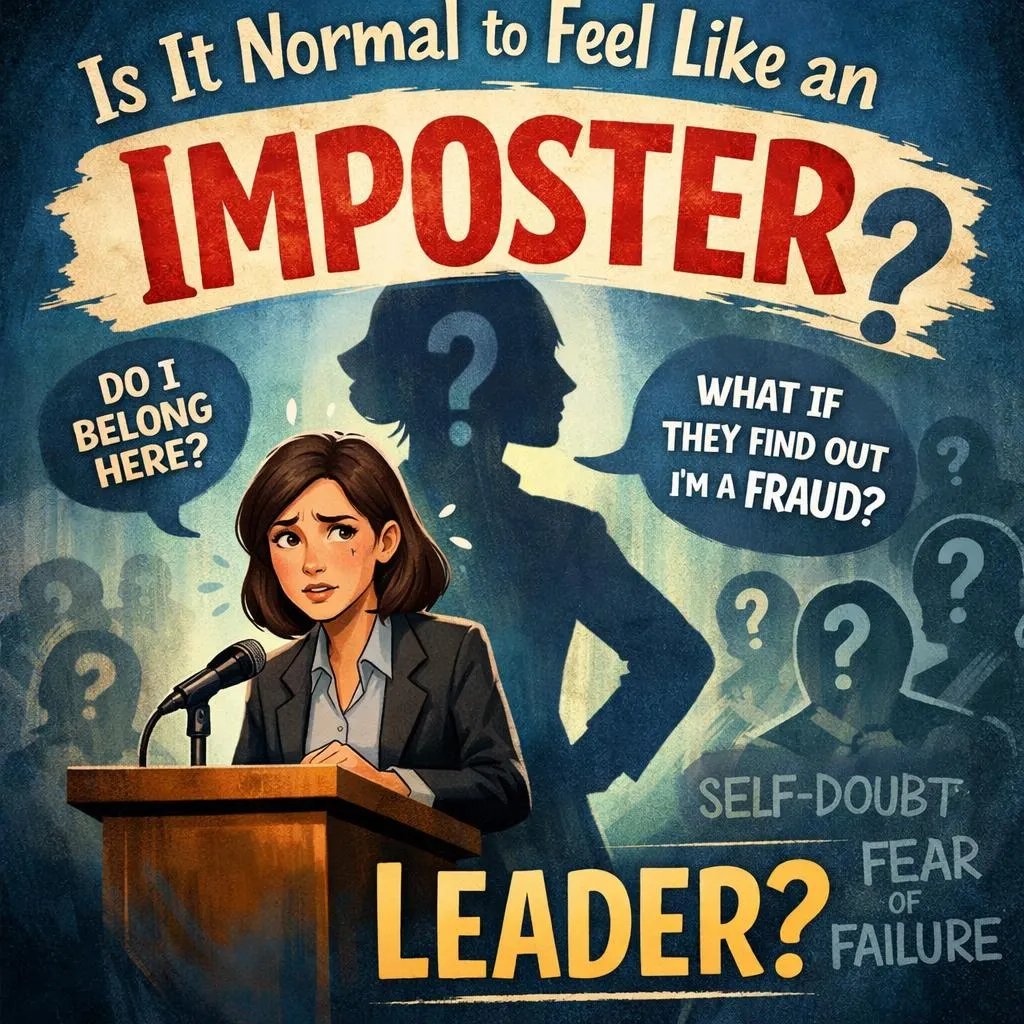
When you speak in front of other people, especially people whose opinion matters, your body often treats that moment as a “please don’t let everyone discover I’m a fraud” threat.
Psychologists call this social-evaluative threat, which basically means you feel like your abilities, intelligence, status, or identity could be judged by other people.
Research by Dickerson and Kemeny found that stressors involving social evaluation can trigger stronger cortisol responses than stressors without that evaluative component.
Translation:
Your body reacts differently when people are watching.
That means the meeting itself can change your access to your own intelligence.
You may know exactly what you want to say before the meeting.
You may understand the issue deeply.
You may have valuable insight.
But when the moment comes, your nervous system goes: “Interesting. What if we deleted the sentence?”
Helpful little gremlin.
This is why so many capable leaders ramble, seize up, or sound less clear than they actually are.
Over-preparing feels safe, but creates a trap

BTW, I know this problem well. I was recently asked to do a presentation for an online community. It was a video submission, and I wanted to nail it. I also wanted to use new material.
It was a one-off presentation, but I wanted it perfect, so I worked out an opening and sat down to write the rest.
5 hours in, I had the perfect script, delivered it to my online speaking community- they were like, ugh.
10 hours in, I delivered it again, and after 5 minutes, I stopped the script and freewheeled because it was garbage.
15 hours in, I went back to old material- ugh.
20 hours in, I was like F it, I'm going back to the new material.
25 hours in, I decided to point form the script for clarity.
30 hours in, I couldn't figure out the through-line message.
35 hours in, I just turned on the camera and went for it.
40 hours, still didn't like.
45 hours, I stepped completely away from the notes and saw the vision.
50 hours, F it, I turned on the camera and dropped pure gold. A totally different version than my original, scripted, garbage.
My point is:
Those first 10 hours were the trap. You write everything down and think: “Okay. Now I’m ready.”
But what do most leaders do... well, they don't have a practice audience, so they double down on the first 10 hours, spending another 10 hours memorizing it, and it flops. That's over-preparing.
You put all that time in, you're dependent on your words, but when you deliver the words for the first time, they are crap!!!
Now your confidence depends on the script.
That works beautifully until you look at the audience and see them praying for this droning presentation to end!
The funny thing is, being overprepared or underprepared has the same effect.
And the worst part?
Presenters walk away thinking, “I’m bad at speaking.”
Well, yes, it's true, but you don't have to be.
Meetings reward clarity, not performance
Most professionals don’t need to become keynote speakers in every meeting.
Nobody is asking you to walk into the Monday operations call and deliver the Gettysburg Address.
What people need is much simpler:
What’s the point?
Why does it matter?
What do we do next?
That’s it.
Executive communication is about reducing confusion.
McKinsey has written about how better meetings support better decision-making, especially when the purpose, preparation, and decision process are clear. They also emphasize that effective meetings rely on purpose, preparation, and presentation.
And this matters because unclear communication creates hidden costs.
Decisions take longer.
People leave with different interpretations.
Teams revisit the same conversation sixteen times.
Someone says, “Just circling back,” and another small part of humanity dies.
Clarity speeds things up.
The real skill: brainstorm before you speak
This is where I went wrong. I never brainstormed. I knew I wanted new material, but I was unclear about what point I wanted to make.
Finding that one point was the entire holdup of my presentation.
Hey, maybe you want to make 2 or 3 points. Excellent, get clear on that first.
I struggled getting clear on my point for this specific event, BUT if I were going into a meeting, my notes would say: I want to talk about point 1. Point 2. Point 3. And here is action step 1. Action step 2. Action step 3.
Boom, now I know my point and what I want people to do. Now I just give one example for each point, and I'm golden.
Same deal... I'm asked to speak up in a meeting; I make my one point, support it with a "why it matters," and what I want people to do.
It's bulletproof, and people are going to thank you for not droning on, and you are going to feel better about sharing tangible points.
What. Why. Action.
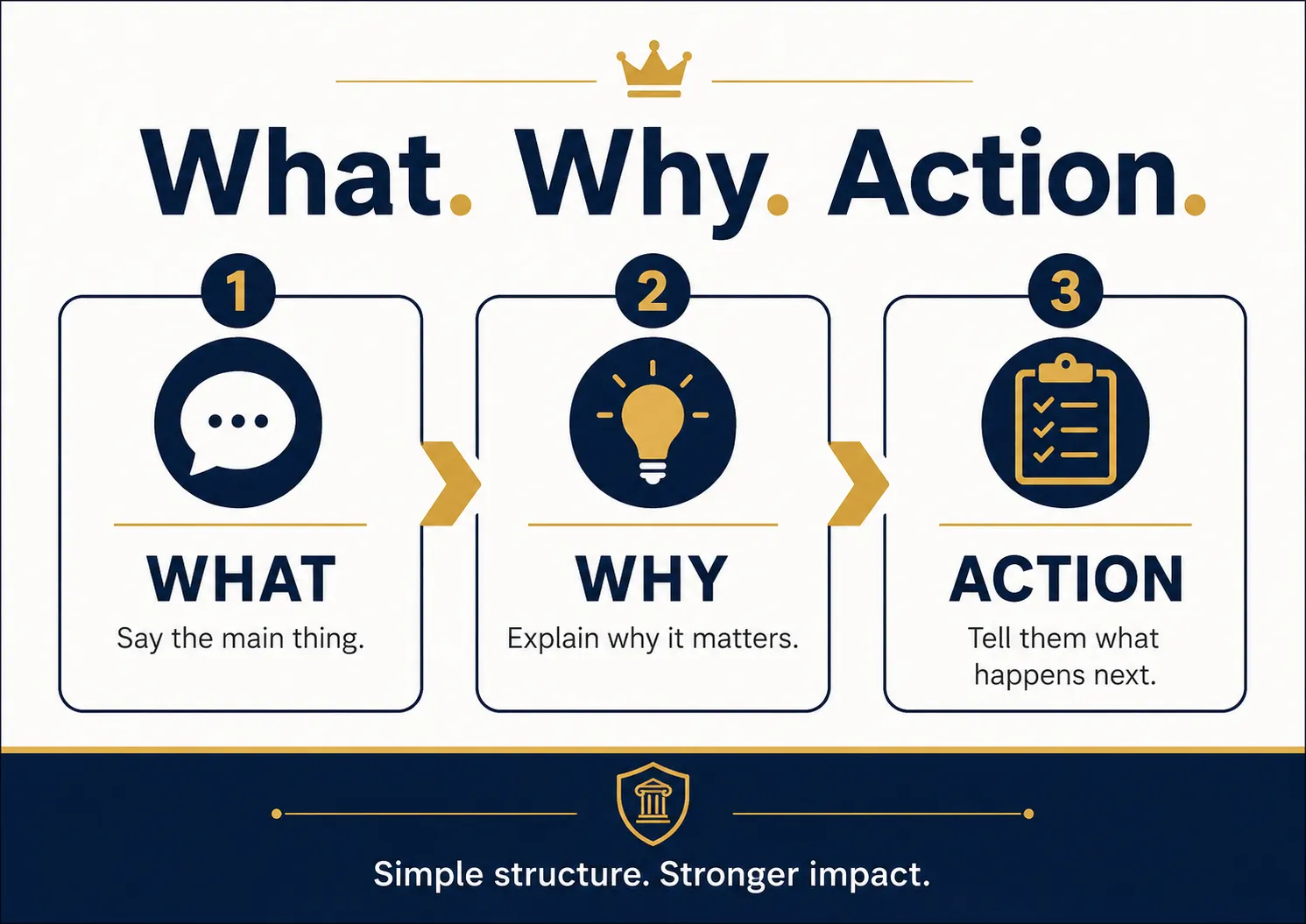
What: Say the main thing.
Why: Explain why it matters.
Action: What do they do next?
For example, instead of saying:
“Yeah, I think there’s a lot to consider, and we should maybe look at the customer side and also the internal timeline because there are a few moving parts… blah, blah, blah.”
You could say:
What: I propose delaying the launch by two weeks.
Why: My reason, the customer onboarding process isn't ready yet, and if we launch now, we’ll create more support issues than we gain in momentum. For example, three of the five support docs are still incomplete, and the team has already flagged confusion around setup.
Action: My recommendation is simple: delay by two weeks, complete onboarding properly, and launch with fewer avoidable fires. Thoughts?”
Easy.
Your audience does not need everything in your head
Another major reason people ramble...
They try to say everything they know.
But your job is not to unload your entire brain onto the conference table like a Costco-sized bag of expertise.
Your job is to give people a useful piece of understanding.
That means you have to ask:
“What does this audience need from me right now?”
Not:
“How do I prove I’m smart?”
Try this before your next presentation
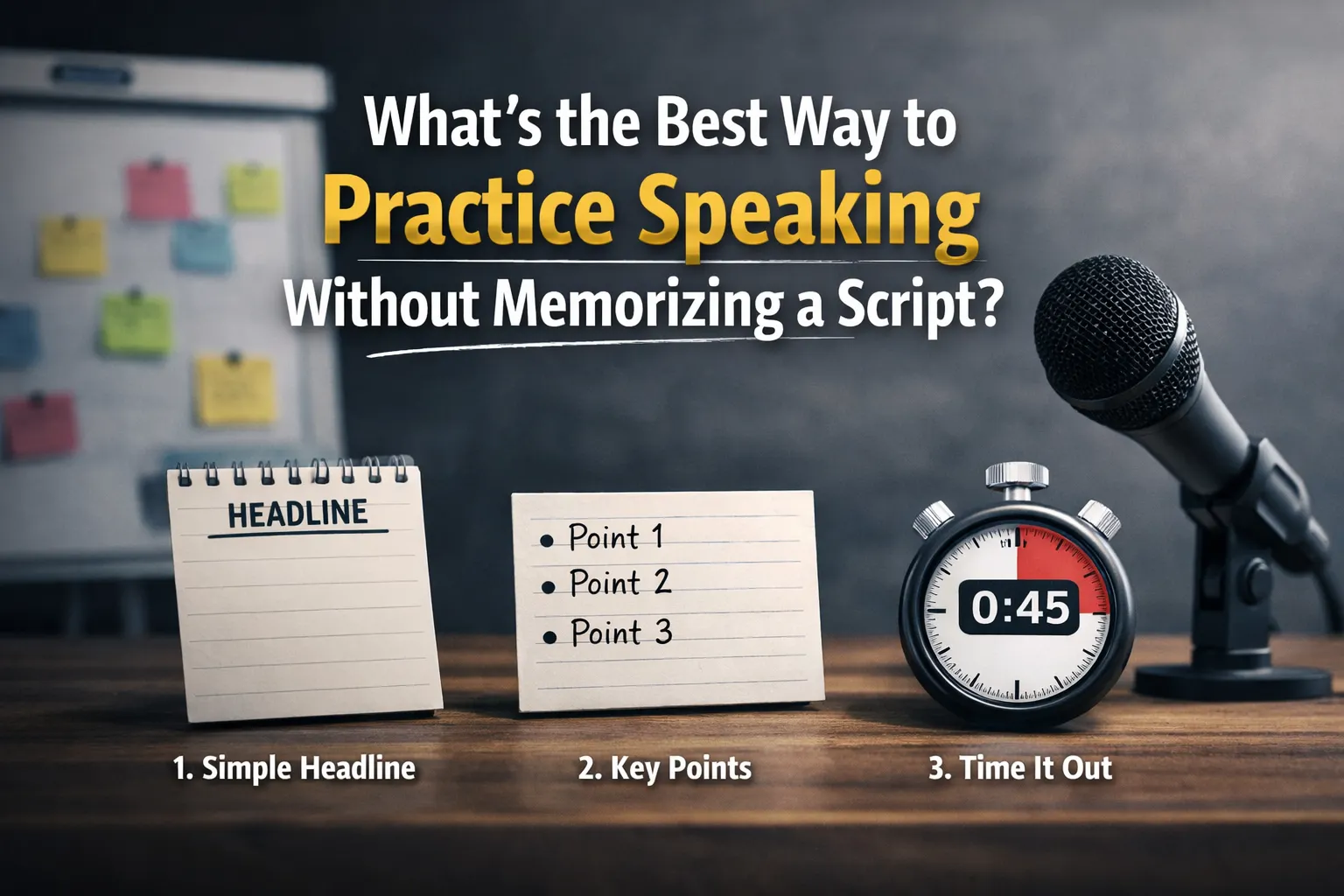
Before your next meeting, don’t write a script.
Write three lines.
1. My main point(s) is/are:
What do you want them to understand?
2. This matters because (clear for each point):
Why should they care?
3. The next step is:
What should happen after you speak?
A structure says: “Here’s the path. Walk it in your own words.”
The less you memorize, the more natural you sound
Now throw away any script.
Bring your notes if necessary, but include only your main points and takeaways.
When asked a question, use the same dang structure.
When you know your point, your reason, your example, and your ask, you can adapt to any question.
Clear speaking builds trust
People trust leaders who make things easier to understand.
Because clarity tells people:
“I know what I mean.”
“I understand what matters.”
“I can help us move forward.”
That is why communication training matters at the leadership level.
When leaders speak clearly, decisions get easier. Meetings get shorter. People stop guessing. Work moves.
Beautiful.
Want a simple place to start?
Before you start worrying, start practicing. You can practice this in many conversations almost every day. Simply respond to questions and bark orders using this framework:
My point is…
This matters because…
So the next step is…
That tiny structure can save you from rambling, freezing, or accidentally saying “alignment” nine times in one sentence.
Want more???
Magnetic Message Blueprint: Stop Freezing Mid-Talk Without Memorizing Scripts
Cited Works
1. King, P. E., & Finn, A. N.
A Test of Attention Control Theory in Public Speaking: Cognitive Load Influences the Relationship Between State Anxiety and Verbal Production.
Used to support the point that anxiety and cognitive load can affect speaking performance.
2. Dickerson, S. S., & Kemeny, M. E.
Acute Stressors and Cortisol Responses: A Theoretical Integration and Synthesis of Laboratory Research.
Used to support the idea that social-evaluative threat can trigger stronger stress responses.
3. McKinsey & Company
Want a Better Decision? Plan a Better Meeting.
Used to support the connection between meeting structure and better decision-making.
4. McKinsey & Company
What Is an Effective Meeting?
Used to support the importance of purpose, preparation, and presentation in effective meetings.
I’d also add this one if you want the blog to feel even more grounded:
5. Baddeley, A. D.
Working Memory: Looking Back and Looking Forward.
Used to support the idea that when people overload working memory, performance drops, especially when they are trying to hold too much information in mind while speaking.
Related Articles
How Do I Organize My Thoughts Quickly Before I Speak
https://blog.devinbisanz.com/post/how-do-i-organize-my-thoughts-quickly-before-i-speak
What’s The Best Way To Practice Speaking Without Memorizing A Script
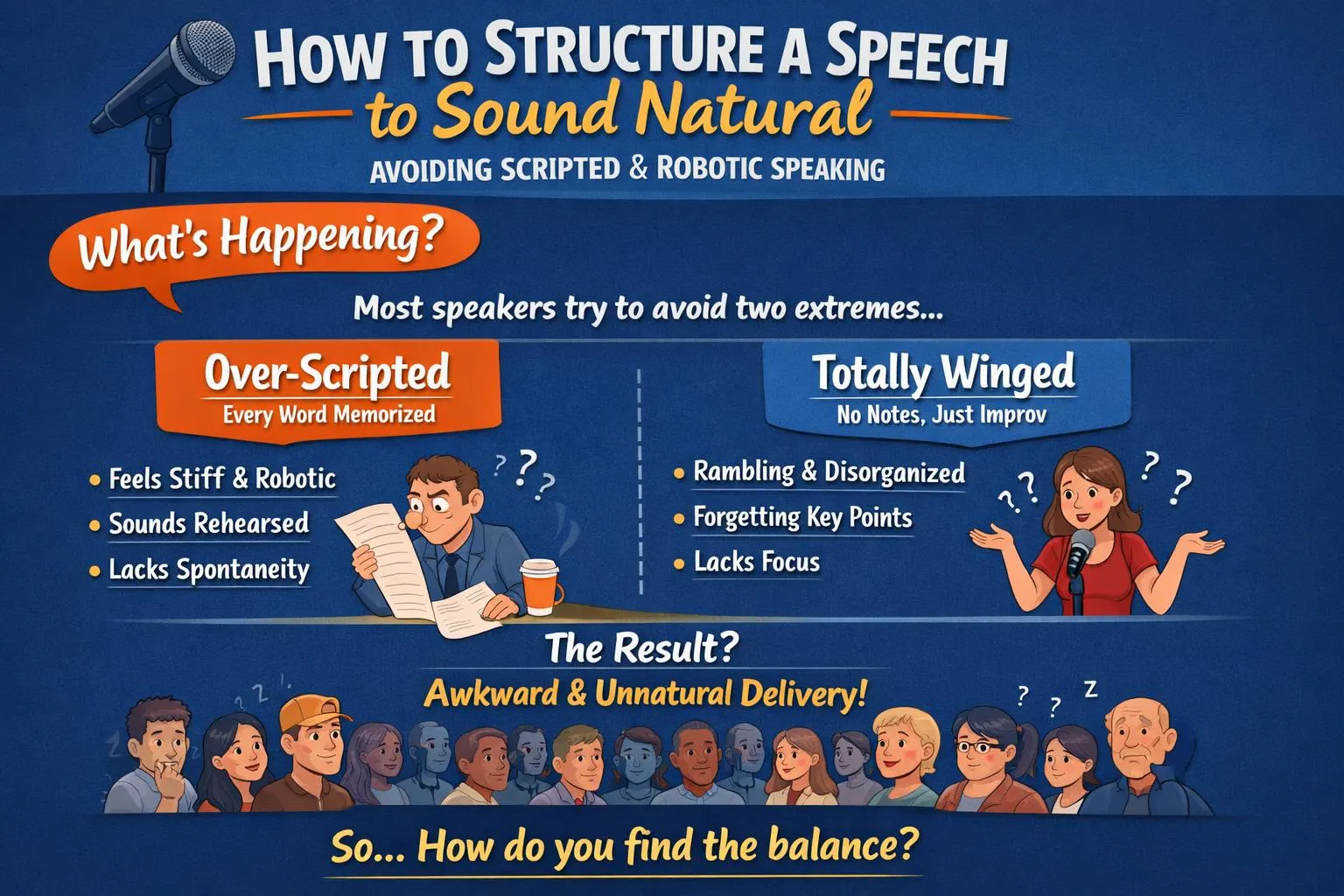
How Should A Speech Be Structured So It Sounds Natural, Not Rehearsed
Why Do I Sound Clear In My Head But Messy When I Speak
https://blog.devinbisanz.com/post/why-do-i-sound-clear-in-my-head-but-messy-when-i-speak
Why Do Confident Professionals Freeze When They Have To Speak Out Loud
5 Habits Of People Who Sound Clear, Confident, And Magnetic
https://blog.devinbisanz.com/post/5-habits-of-people-who-sound-clear-confident-and-magnetic
The Trust Factor: How Clear Communication Wins Any Audience
https://blog.devinbisanz.com/post/the-trust-factor-how-clear-communication-wins-any-audience