How to Build a Story Bank: Never Run Out of Stories for Public Speaking
How to Build a Story Bank: Never Run Out of Stories for Public Speaking
Oct 05, 2026
Something probably happened this week that would make a great story.
Something went wrong.
Someone said something ridiculous.
You made a mistake.
Your kid asked you a question that stopped you in your tracks.
A client taught you something.
You changed your mind about something you'd believed for years.
A funny joke.
And there's a pretty good chance you're going to forget it.
That's the problem.
Most people don't lack stories.
They lack storage.
Professional speakers, comedians, writers and great communicators learn to capture stories while they're still fresh.
You should too.
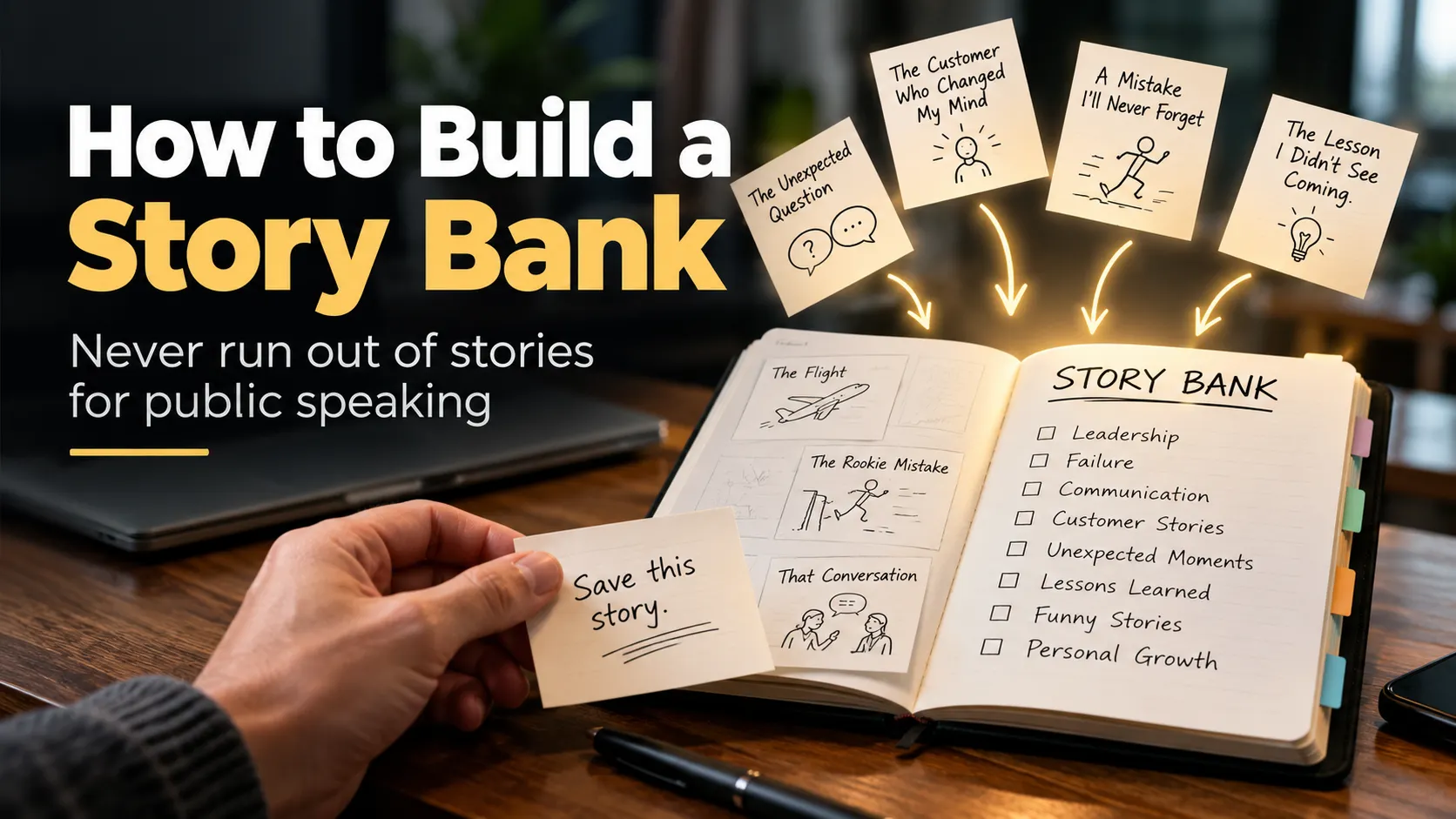
That's where a story bank comes in.
What is a story bank?
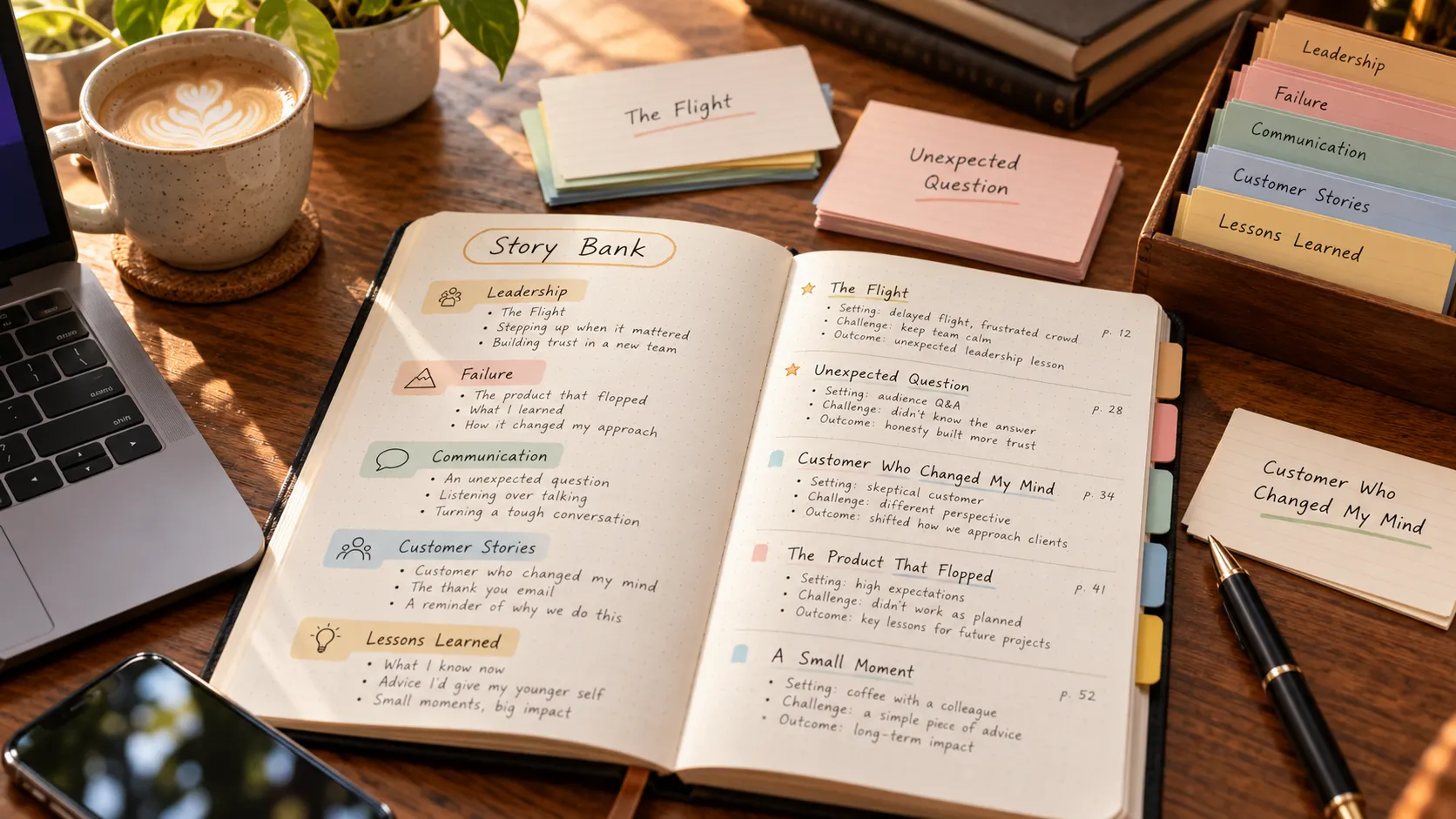
A story bank is a collection of experiences, moments, observations and lessons that you save so you can use them later in speeches, presentations, meetings, content or conversations.
Think of it as your personal library of speaking material.
Instead of sitting down the night before a presentation thinking:
“I need a good story…”
You open your story bank and choose one.
That's a very different way to prepare.
And it's one of the habits that separates someone who occasionally tells a good story from someone who can consistently communicate through stories.
Professional speaking organizations teach a similar practice. Toastmasters recommends recording moments as you notice them, labelling stories with the lessons they illustrate, and building a searchable library over time.
You're probably forgetting your best stories
Here's the mistake most of us make.
Something interesting happens, and we think: I'll remember that.
Of course you will.
For approximately eleven minutes.
Then somebody asks what's for dinner, you get six emails, your phone rings, and life keeps moving.
A few days later, you might remember that something happened.
But you've lost the good stuff.
The exact sentence somebody said.
The look on their face.
The weird little detail that made the moment funny.
How you felt before it happened.
What changed afterward.
Those details are often what make the story worth telling.
So don't trust your memory.
Capture the story while you still have it.
Why storytelling matters in public speaking
Stories aren't just decoration you add to make a presentation more entertaining.
They help people understand what you mean.
A good story can take an abstract idea like leadership, trust, accountability or communication and turn it into something the audience can actually picture.
That's why storytelling is used so heavily in speeches and presentations.
Toastmasters points out that stories can make lessons relatable and memorable, while leadership-development organizations increasingly treat storytelling as a practical communication tool for explaining decisions, creating context and helping people understand complex ideas. Schulich ExecEd
And that's especially important in business.
A manager can say:
“We need people to take greater ownership.”
Okay.
Or she can tell the 60-second story about the employee who saw a problem and solved it before it became a $40,000 problem.
Now people understand what ownership looks like.
Stories turn concepts into examples.
The competitive advantage of having a story bank
Imagine two people have to give a presentation Friday.
Person one starts looking for stories Thursday night.
They stare at the screen.
Nothing.
So they Google something, ask AI for an example, or use some generic story everyone has heard before.
Person two has been collecting experiences for the past year.
They open their story bank.
There are 73 possibilities.
Leadership.
Failure.
Conflict.
Customer service.
Bad decisions.
Risk.
Parenting.
Communication.
Embarrassment.
Persistence.
Now the problem isn't:
“Do I have a story?”
It's:
“Which story should I use?”
That's an enormous advantage.
And it doesn't only apply to keynote speakers.
A story bank helps you in:
- presentations
- leadership meetings
- sales conversations
- job interviews
- training
- coaching
- social media
- podcasts
- team meetings
- difficult conversations
- answering questions on the spot
The more responsibility you have, the more useful this becomes.
What should you put in a story bank?
This is where people overcomplicate the process.
You're not writing the finished story.
You're catching the raw material.
When something worth remembering happens, capture four things.
1. What happened?
Give yourself enough information to remember the event.
Not:
“Hotel story.”
Six months from now, that means absolutely nothing.
Instead:
“Hotel gave away my room even though I had confirmation.”
Now you've got something.
2. What was interesting about it?
Save the detail that made you notice the moment.
Maybe it was something somebody said.
Maybe it was your reaction.
Maybe everything went spectacularly wrong.
Maybe it had a happy ending and a lesson.
That's usually where the story lives.
3. What's the lesson?
Ask:
What could this story help me explain?
That hotel story might become a story about:
- ownership
- customer service
- leadership
- problem solving
- accountability
One story can support several different messages.
That's important.
You don't necessarily need hundreds of different stories.
You need stories you understand well enough to use in different ways.
4. When could I use it?
Give the story some tags.
For example:
Leadership/ownership/customer experience/problem solving
That makes it much easier to find later.
Don't wait for “big” stories
This is another mistake.
People think storytelling requires something dramatic.
Climbing Everest.
Losing millions of dollars.
Nearly dying.
Launching a billion-dollar company.
Relax.
Some of the best speaking material comes from incredibly ordinary experiences.
A strange conversation at Starbucks.
Something you heard at the gym.
A mistake at work.
A disagreement with your spouse.
Buying the wrong thing.
Missing the bus.
Trying to fix something yourself and making it worse.
The event doesn't have to be extraordinary.
The insight does.
Recent public-speaking guidance makes the same point: effective stories can come from small, true incidents rather than dramatic life events; what matters is finding the moment of change and connecting it to one clear point. Orator
How to find stories for a speech or presentation
Once you start building your story bank, preparing becomes backwards from the way most people do it.
Don't ask:
“What's an impressive story I can tell?”
Start with:
“What's the point I'm trying to make?”
Then search your stories for an experience that demonstrates it.
If your point is:
Good leaders take ownership.
Search ownership.
If your point is:
Preparation doesn't guarantee performance.
Search preparation, failure, or pressure.
If your point is:
People remember how you respond when things go wrong.
Search customer service, mistakes, or conflict.
The story serves the message.
Not the other way around.
Toastmasters similarly recommends choosing stories based on whether they clearly support the point of the speech rather than including a story simply because you enjoy telling it. Toastmasters International

How long should a story be in a presentation?
Usually shorter than you think.
You don't need to tell us everything that happened that Tuesday.
We don't need to know what you had for breakfast unless the pancakes become critically important in Act Three.
Give us enough to understand:
Where were you?
What was happening?
What went wrong or changed?
What happened next?
Why does it matter?
Then get out.
One of the biggest differences between normal conversation and effective public-speaking storytelling is editing.
You're removing everything the audience doesn't need.
Everything.
But remember the unique aspects. Bring those to life!
My rule: save first, polish later
When I capture a story, I don't worry about making it brilliant.
That's not the job yet.
First:
Save it.
Later, when I actually need the story, I can work on:
- the opening
- tension
- unnecessary details
- dialogue
- pacing
- the lesson
- the ending
Trying to perfectly craft every story when you capture it creates too much friction.
And friction kills the habit.
Think:
Capture → organize → develop → use.
Not:
Write a TED Talk every time something mildly interesting happens.
Why I built a Storybank into my speaking app
This problem eventually became something I wanted to solve inside the speaking app I'm building.
I wanted people to have somewhere to quickly save:
- what happened
- the lesson
- where they could use it
- quotes
- jokes
- observations
- story ideas
Then, when they're preparing a presentation or trying to communicate an idea, they already have material.
More importantly, they start paying attention to their own life in a different way.
That's one of the unexpected benefits of keeping a story bank.
Once you start collecting stories, you start noticing stories.
And suddenly you realize:
Yes, you are boring (jk).
You are also not boring.
Perhaps you just never thought about what makes you unique... and leaned into it.
Start your story bank today
Don't overcomplicate this.
You don't need an app.
You don't need some elaborate Notion template.
Open the Notes app on your phone if that's what you'll actually use.
Create a note called:
STORY BANK
Then start paying attention.
When something makes you laugh, think, cringe, change your mind or learn something…
write it down.
You can figure out how to tell the story later.
Because when it's time to give the presentation, lead the meeting or explain an important idea, you don't want to be desperately trying to invent something memorable.
You want to open the bank.
Story Bank FAQ
What is a story bank?
A story bank is an organized collection of personal experiences, examples, observations and lessons that you can draw from when preparing speeches, presentations, content or important conversations.
Who should keep a story bank?
Speakers, leaders, managers, coaches, sales professionals, content creators and anyone who regularly needs to communicate ideas can benefit from keeping one.
What should I save in a story bank?
Save moments involving change, mistakes, conflict, surprises, lessons, funny experiences, customer interactions, conversations, failures, successes and observations that might illustrate an idea later.
How do professional speakers find stories?
Many professional speakers deliberately capture everyday experiences rather than waiting until they're preparing a speech. They then organize those experiences around themes or lessons so they can retrieve the right story when they need it.
How many stories do I need?
Start with ten.
Don't worry about having hundreds. Ten useful stories that you understand and can adapt to different messages are more valuable than a giant database you never use.
Can one story be used for different topics?
Absolutely. The meaning of a story often depends on how you frame it. The same experience might illustrate leadership, communication, persistence or decision-making depending on the point you're making.
Related Posts
How to Speak Clearly Without Overpreparing
Clear In Your Head, Messy When You Speak
How to Turn an Everyday Experience Into a Story
Coming Soon:
Build a Story Bank
How to Find Stories for a Speech
How to Tell a Story Without Rambling
How Long Should a Story Be in a Presentation?
Business Storytelling for Leaders