Why do confident professionals freeze when they have to speak out loud?
Why do confident professionals freeze when they have to speak out loud?
Jan 04, 2026
It’s tempting to believe that confident professionals freeze because they lack knowledge or intelligence.
They don’t.
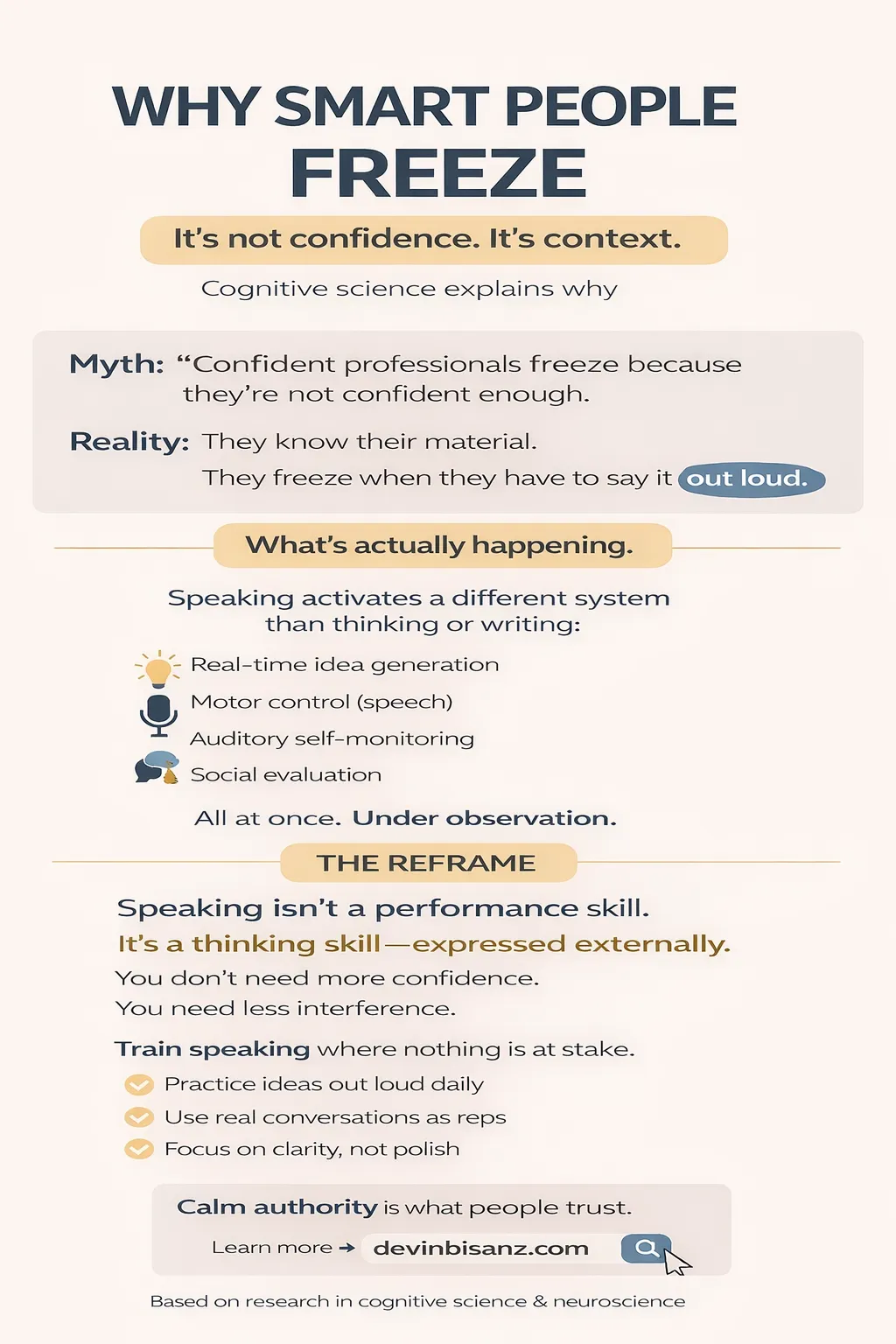
They freeze because speaking out loud activates a different mental system than thinking or writing:
Unlike thinking or writing, speaking requires real-time motor control, auditory self-monitoring, and social evaluation: systems that have been shown to increase cognitive load and stress under observation (Price, 2012; Dickerson & Kemeny, 2004).
When you’re in your head, you have unlimited time. You can refine, reorder, and polish ideas before anyone sees them.
When you speak consciously, you’re suddenly aware of eyes on you. Judgment feels possible. Silence feels loud.
Once you understand that this isn’t a confidence problem but a context shift, the problem stops being mysterious and starts being solvable.
What’s actually happening
Speaking under observation activates your threat response.
Your brain starts monitoring itself in real time: How do I sound? Is this clear? Am I rambling?
That self-monitoring creates lag.
Lag turns into hesitation.
The more you care about sounding smart, the more monitoring happens and the more likely you are to freeze.
This isn’t a weakness. It’s biology.
Speaking under observation activates the brain’s threat and self-monitoring systems, increasing cognitive load and stress hormones that interfere with working memory and verbal fluency (Dickerson & Kemeny, 2004). Neuroimaging research also shows that overt speech recruits additional motor and auditory feedback networks compared to silent thinking or writing, making real-time speaking more demanding by default (Price, 2012).

The common misdiagnosis
Most people assume they need to “be more confident.”
So they hype themselves up.
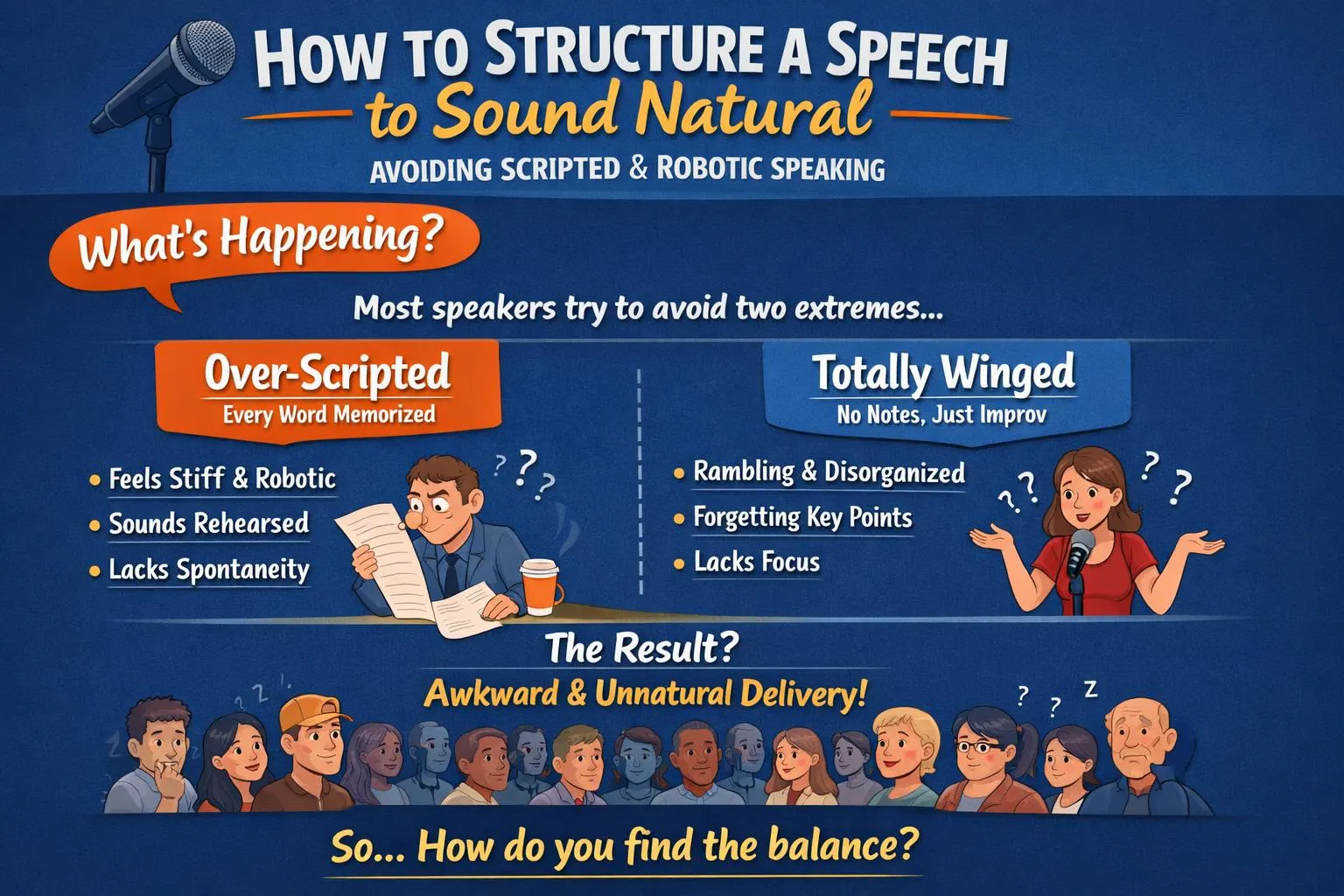
They rehearse harder.
They memorize lines.
That’s like treating a physiological response as a character flaw. And it doesn’t work- because pressure doesn’t disappear because you practiced confidence in the mirror.
In fact...
Pressure increases. On the one hand, you might be feeling overconfident and blow it, sounding arrogant, OR... you're looking around the room when you arrive, and you're like, "Did I practice the right things?" "Sheesh, they're not the audience I imagined. I'm screwed!"
Boom, pressure doubles.
The reframe
Nobody is bad at speaking.
Okay, wait, that's not true...
Sadly, some people are horrendous at speaking!
Because of that, they are even worse when speaking under pressure.
For the rest of us...
Speaking is a skill set. It's a series of exercises that, when performed right, become a part of who you are. Influence, power, seduction and charm become something a speaker can turn on or off.
Yes, you have your old ways, the fear, the pressure; you can always access Scardy Cat self.
But now...
You have the skill set to access the right character for the moment.
Have you ever heard the saying: take care of the small money, and the big money takes care of itself?
That's exactly how it works when speaking, if you take care of the small conversations, by becoming conscious of what and how you communicate. If you use punchlines purposefully and are aware of your body language and storytelling during talks with your friends, family, and clients...
... when you get on stage, you'll speak unconsciously, move with grace, and activate your complete authenticity, saying the exact right things at the right time, completely unconsciously.
Speaking isn’t a performance skill - it’s a thinking skill, expressed externally.
Cognitive science shows that language is a core mechanism for organizing and developing thought, not merely for presenting finished ideas (Vygotsky, 1987). Models of speech production further demonstrate that speaking involves real-time conceptual planning and formulation, meaning thought is actively constructed through speech, not simply performed after the fact (Levelt, 1989).
Your job isn’t to seem friendly. It's to be trustworthy.
Your expertise is already there. You don’t need to add confidence; you need to remove interference.

What to do instead
Work with me, it's the smartest thing you can invest in. :)
But before you do that, here is a game-changing nugget you can practice today.
Take a single line, a punchline, OR a quote works great... in fact, let's go with a quote.
Take one quote, and work it into the next five conversations you have.
Sometimes the quote won't fit perfectly into the conversation. That's okay, force it. You may forget a part of the quote because you're thinking too much. Excellent progress. You may nail it all five times. Perfect, now do the same exercise with a story or joke you're working on.
The point is that you become aware of what and how you talk- always. That's the game changer.
Broader implication
When you stop freezing, something subtle shifts.
You don’t sound louder or more charismatic.
You sound influential.
And calm authority is what people actually trust.
Stay Empowered,
Devin
Related posts:
- Why do I sound clear in my head but messy when I speak?
- Why does speaking feel harder as my role gets bigger?
- Why do smart people feel embarrassed that public speaking is still hard?
- Is public speaking anxiety a confidence problem or a training problem?
- Why do I ramble even when I know my topic well?
- How do I stop overthinking every sentence when I speak?
For more resources and coaching, visit our homepage: https://devinbisanz.cominspire confidence, and that translates into career opportunities and influence.
Cited Works
This article draws on established research in cognitive science and neuroscience examining speech production, inner speech, and stress under social evaluation.
Key sources include:
- Vygotsky, L. S. (1987). Thinking and Speech https://www.marxists.org/archive/vygotsky/works/thinking-and-speech/
- Levelt, W. J. M. (1989). Speaking: From Intention to Articulation
https://mitpress.mit.edu/9780262620604/speaking/
- Price, C. J. (2012). A review and synthesis of the first 20 years of PET and fMRI studies of heard speech, spoken language, and reading https://www.sciencedirect.com/science/article/pii/S1053811912001026
- Dickerson, S. S., & Kemeny, M. E. (2004). Acute stressors and cortisol responses: A theoretical integration and synthesis of laboratory research https://pubmed.ncbi.nlm.nih.gov/15122924/