Why do I sound clear in my head but messy when I speak?
Why do I sound clear in my head but messy when I speak?
Jan 04, 2026
Have you ever experienced the frustrating gap between how clear ideas feel internally and how messy they sound when spoken out loud?
Inside your head, everything feels sharp.
Logical.
Connected.
When you start talking... well, in my personal experience, the more time I spend thinking about an excellent punchline or must-tell story, the more it comes out all wrong and flops!
This doesn’t happen because your thinking is flawed.
It happens because thinking and speaking are fundamentally different processes.
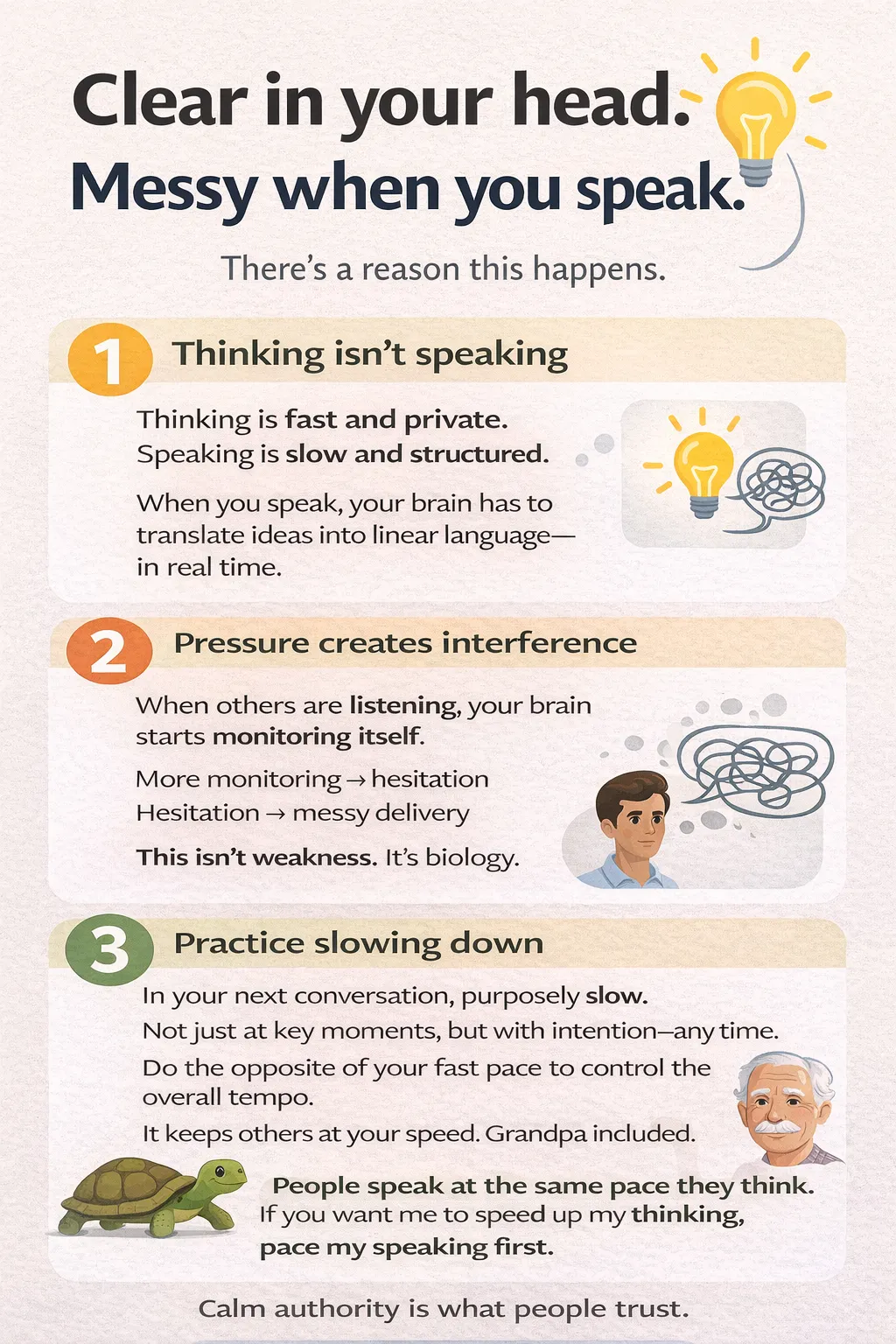
Thinking is private and fast. You don’t need to finish sentences or arrange ideas in a neat order.
Speaking forces you to slow down, structure those thoughts, and make them understandable to someone else.
That translation step is where things fall apart.
What’s Actually Happening
Inside your head, ideas can jump freely.
You can skip steps.
You can hold multiple concepts at once.
When you speak, those ideas must be translated into linear language; one word, one sentence, one idea at a time.
That translation relies heavily on working memory, the system responsible for holding and organizing information in real time (Baddeley, 2003).
When other people are listening, your brain also activates self-monitoring and social-evaluation systems, checking how you sound as you’re still thinking.
That extra load increases cognitive strain and often triggers a mild threat response, making you overanalyze each word as you say it (Price, 2012; Dickerson & Kemeny, 2004).
The result?
Thoughts that felt clear internally start to feel disorganized out loud.
The Common Misdiagnosis
Most people don’t understand what’s happening, so they jump to the wrong conclusion.
They assume:
- “I’m just not good at speaking.”
- “I must not be as articulate as I thought.”
- “I need to memorize exactly what I’m going to say.”
This mislabels a skill gap as a personal flaw.
Memorization might temporarily reduce uncertainty, but it increases pressure.
Pressure increases self-monitoring.
And self-monitoring makes the problem worse.
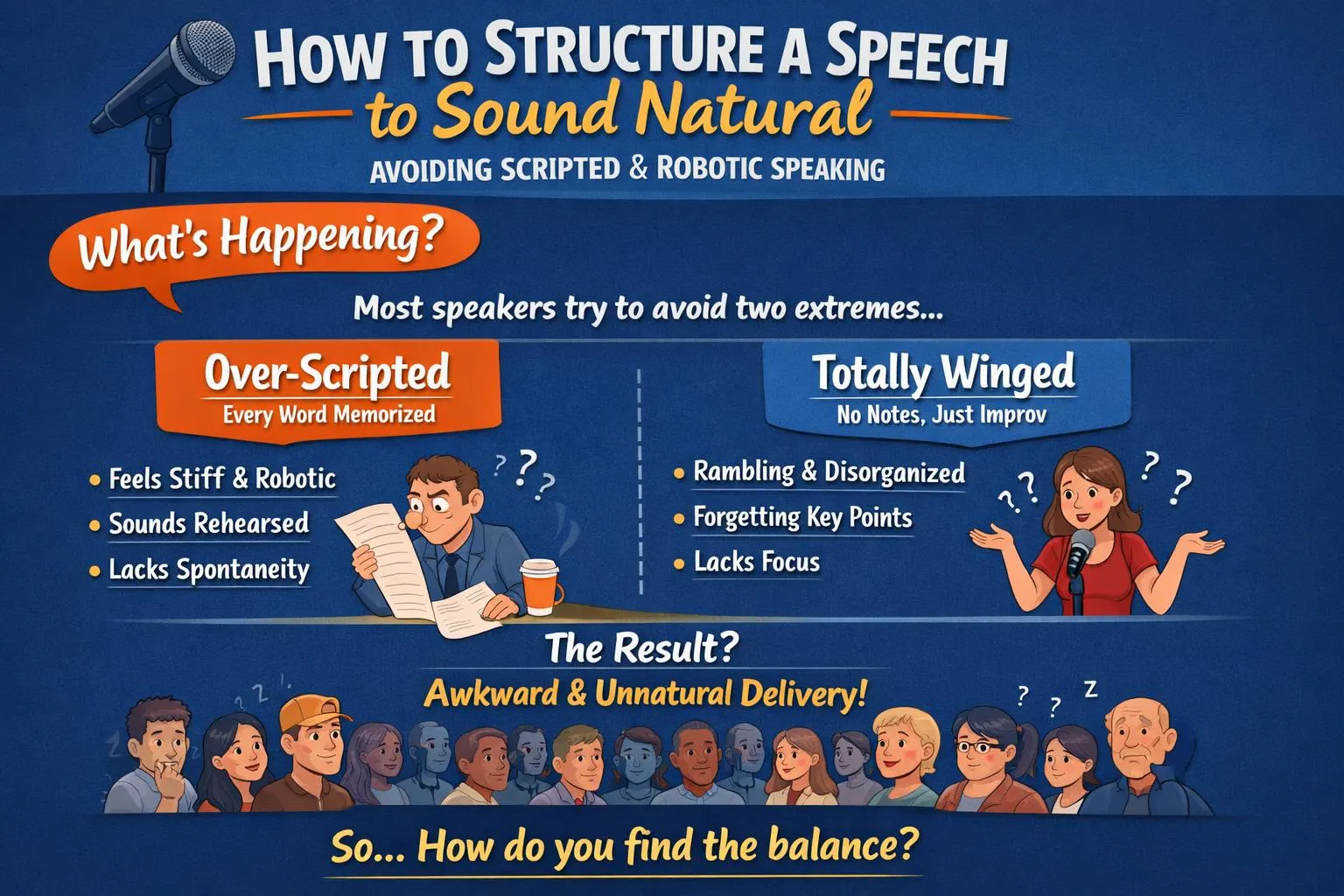
That’s why over-preparing often leads to sounding robotic or going completely blank.
The Reframe
Your thinking isn’t the problem.
The gap is in externalizing your thinking under time pressure.
You’re not consciously converting internal clarity into spoken structure while being observed.
That doesn’t mean you’re bad at communication.
It means you haven’t trained this specific skill.
Speaking clearly is not about having better ideas.
It’s about practicing how ideas move from mind → mouth → listener.
And that skill is trainable.
What to Do Instead
Slow the process down. Both thinking speed and speaking speed.
Speak one idea at a time, not five at once.
Do this:
During your next conversation(s), purposely slow down, not even at key moments, just anytime during the conversation. Slow down the opening sentence, or slow down in the middle of your story, or, if you want to add one sentence to a conversation, speak it slowly (especially if you are a fast speaker).
Who cares if people notice or not? The intention is to pace and lead speaking speeds. If you're in a conversation with grandpa and grandpa doesn't speak fast, but you speak fast, guess what... grandpa is going to ask you to repeat yourself a lot.
On the other hand, if you speak slowly and clearly, grandpa is going to get you every time.
The ability to speak slowly and quickly not only helps you clarify ideas, but also gives you the superpower to pace and lead the speaking pace.
The big takeaway: people speak at the same pace they think. That means that if you want me to speed up my thinking, you have to be able to pace my speaking speed before taking me into your fast-speaking world.
If you're one of those speakers who say, "I'm a fast talker, so keep up or get out." I'm getting out of there!
Before meetings or talks, write a few bullet points, not full sentences. Bullets guide thinking; scripts increase pressure.
Practice explaining ideas/stories/concepts out loud in low-stakes settings:
- to a friend, and then another
- on a voice memo
- during everyday conversations
Focus on clarity over polish.
The goal isn’t to sound impressive.
It’s to let your thinking unfold in real time without interference.
The Broader Implication
When your spoken words match your internal clarity, something important happens.
People understand you better.
They trust you more quickly.
Your ideas carry weight.
When an overthought punchline fails, or a story flops, it's not the norm; it's just what happens once in a while.
"You gotta dig a lot of dirt to find gold!"
Bridging the gap between clear thinking and clear speaking isn’t about confidence—it’s about alignment.
And alignment is what builds credibility and influence over time.
Stay Empowered,
Devin
Related posts:
- Why do confident professionals freeze when they have to speak out loud?
- Why does speaking feel harder as my role gets bigger?
- Why do smart people feel embarrassed that public speaking is still hard?
- Is public speaking anxiety a confidence problem or a training problem?
- Why do I ramble even when I know my topic well?
- How do I stop overthinking every sentence when I speak?
For more resources and coaching, visit:
Cited Works
This article draws on established research in cognitive science and neuroscience examining working memory, speech production, self-monitoring, and stress under social evaluation.
Key sources include:
- Baddeley, A. (2003). Working memory: Looking back and looking forward. https://home.csulb.edu/~cwallis/382/readings/482/baddeley.pdf
- Dickerson, S. S., & Kemeny, M. E. (2004). Acute stressors and cortisol responses: A theoretical integration and synthesis of laboratory research. https://pubmed.ncbi.nlm.nih.gov/15122924/
For more resources and coaching, visit our homepage: https://devinbisanz.com build credibility and influence in your professional life.