Why does speaking feel harder as my role gets bigger?
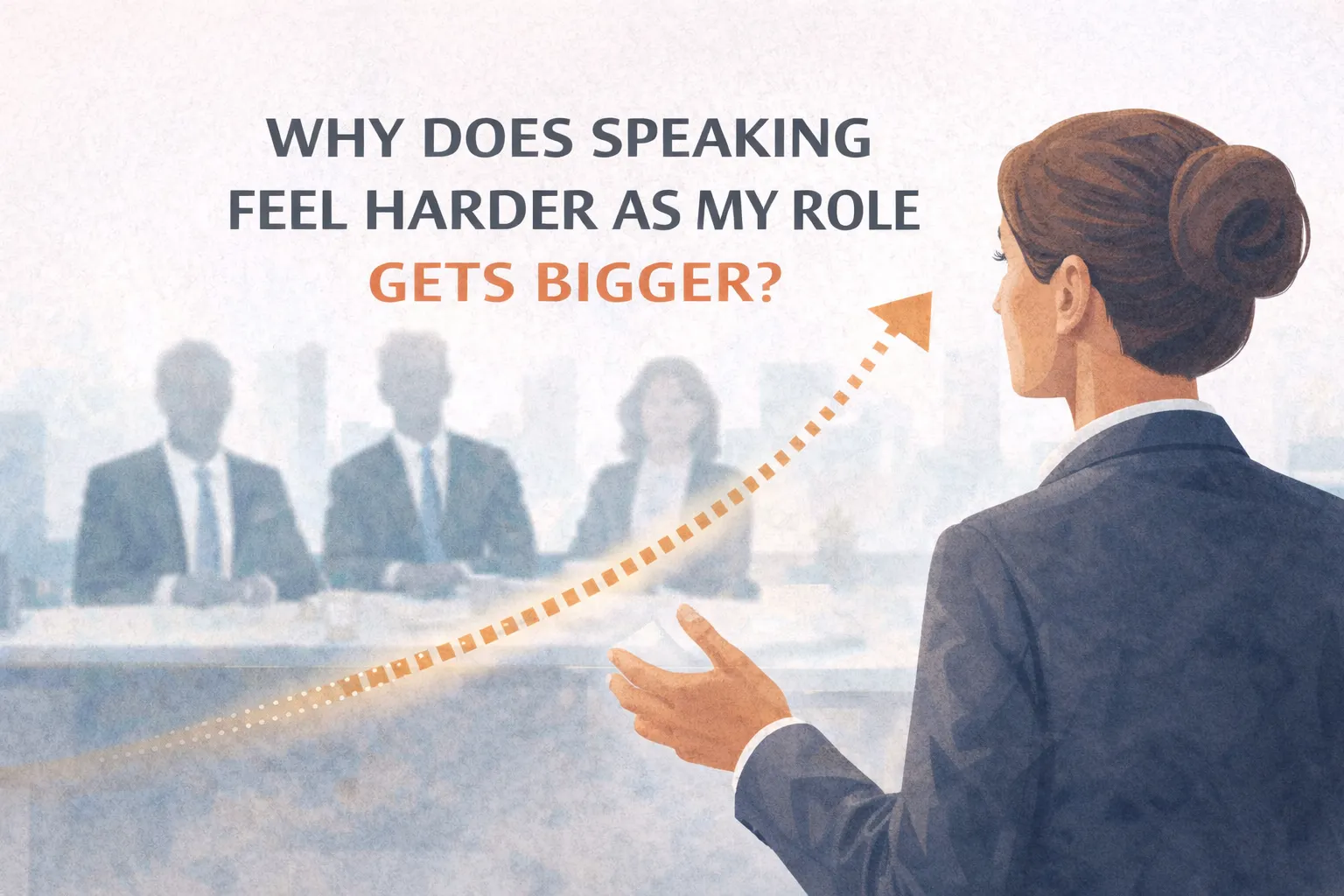
Why does speaking feel harder as my role gets bigger?
Jan 04, 2026
Many professionals notice something unsettling as they step into bigger roles.
Speaking feels harder.
Not because they care less.
They're not less prepared.
But... the stakes have changed.
With more responsibility comes more visibility, more consequence, and more discerning audiences. You’re expected to communicate complex ideas succinctly, often with less time to prepare, while projecting leadership and confidence.
That shift alone is enough to make speaking feel heavier.
What’s Actually Happening
As your role grows, the cognitive demands of speaking grow with it.
You’re no longer just passing along a message. You’re expected to:
- think strategically
- anticipate second-order consequences
- align multiple stakeholders
- signal competence, authority, and direction
All while speaking in real time.
Research shows that higher perceived stakes increase cognitive load and activate stress responses that interfere with working memory and verbal fluency (Baddeley, 2003; Dickerson & Kemeny, 2004).
In simple terms, your brain interprets visible leadership as a risk. Not danger in the dramatic sense, but a social and reputational threat. That threat response diverts resources from fluid thinking to self-monitoring.
The result is familiar:
- You overthink simple points
- You hesitate more than you used to
- You leave conversations thinking, “That should have come out better.”
This is an adaptation under pressure.
The Common Misdiagnosis
Most people get this wrong.
They assume:
- “I used to be better at this.”
- “Maybe I’m not cut out for leadership.”
- “I need to prepare more. Script more. Say less.”
So they overcompensate.
They memorize language that used to come naturally.
They speak less in meetings.
They wait until their ideas feel perfect before sharing them.
But this treats a context shift like a personal flaw.
The problem isn’t that you’ve become a worse speaker.
It’s that the job of speaking has changed.
The Reframe
You’re crossing into a new communication tier.
Speaking effectively at higher levels requires a different skill set. You’re learning how to speak to executives, teams, and stakeholders who listen for clarity, alignment, and judgment.
Just as leadership itself requires new ways of thinking, leadership communication requires new ways of speaking.
And like any skill shift, it feels awkward before it feels natural.
What to Do Instead
Step 1: Awareness. Once you become aware of it, you can solve it. This one tiny part of what I teach could be your solution...
A Practical Exercise: Speak One Level Up
Do this right now... choose one real topic you need to speak about. It could be an update, a decision, or an issue you want to raise.
Now, pause and ask yourself: if I were one level higher than my current role, what would matter most about this?
Then say one sentence that captures:
- why this matters now
- what direction it points toward
- or what decision or alignment it supports
Stop there.
Let the silence exist.
If people ask questions, you can go deeper.
ExAMPLE (just skim down to the one sentence):
Let's say I were speaking to the next role above me in the speaking world. That person is a member of the Canadian Association of Professional Speaking. He holds credentials like HOF, CSP, and a bunch I can't even think of. He has book awards and decades of stage time. All the speakers look up to this speaker for advice on speaker training. Let's say I want to talk to him about influence.
Topic: Influence
What would matter most about this: Proof, understanding, something he doesn't already know.
My one sentence brainstorming (my completion time,15 mins):
Why this matters now: because AI is turning students into robots.
What direction it points toward: it should be on everybody's mind. Love it or fear it, there is a significant possibility that millions of people are at risk of losing jobs. Example: 30 years ago, I worked in a sawmill. In 5 years of working there, new machines replaced half a dozen employees. Five years after I quit, another six jobs were extinct, plus all the other mills in the area, all replacing employees. Today, only a fraction of the workers remain, and 85% of the mills in the region have shut down. That's mechanical robots... AI is a robot war machine. It's taking out students' brains and confidence.
What decision or alignment does it support? Would you be willing to collab on something? I get to ride on his fame, but what's in it for him? I doubt he cares about the money (although all famous speakers do). He is known for his humour... everybody loves him in the speaking world, or they don't... I've heard on the grapevine that he is too over-the-top for the morning speaker... i like that about him, he knows he impacts people... We could collaborate on a book, or he could be a part of my book. What would be cool for him and me??? Ohhh, I'd like to do a bit with him on the conference stage. That's a big ask...
My one sentence (my completion time, 7 mins): Hey (name), the CAPS convention is coming up, and I know you like to make others laugh, and since the next convention is all about humour... and I assume you're going to be a keynote speaker... I'd love to do a comedy/improv/transformation bit with you.
Silence.................
THE AFTERMATH:
The one-sentence doesn't match the run-on sentence from my brainstorming session. You see, when brainstorming, you're just getting the thoughts out: numbers, ideas, stories, analogies. But then you start thinking... what's in it for this person?
That's the shift...
What's in it for the new person is DIFFERENT from what was in it for the person you used to speak to.
What's in it for them?
And maybe you get it wrong, you missed the mark by a mile... excellent! How you react to the situation tells anyone all they need to know about YOU.
What's in it for them, or the company, or their position in life?
More importantly: what's in it for us... win-win.
Stop trying to prove you belong and start sounding like you already do.
Note: Brainstorming is the best habit a speaker can develop. You have to get the garbage (and gold) out of your head!
The Broader Implication
As your role expands, you master speaking, and something subtle but essential happens.
People trust you with even bigger conversations.
They listen differently.
They see you as someone of influence.
They see you as someone who matters in the room.
Very Best,
Devin Bisanz
Related posts:
- Why do confident professionals freeze when they have to speak out loud?
- Why do I sound clear in my head but messy when I speak?
- Coming soon (enter your name in the sidebar email box)
- Why do smart people feel embarrassed that public speaking is still hard?
- Is public speaking anxiety a confidence problem or a training problem?
- Why do I ramble even when I know my topic well?
- How do I stop overthinking every sentence when I speak?
For more resources and coaching, visit:
Cited Works
This article draws on research from cognitive science and psychology examining working memory, stress under social evaluation, and cognitive load in high-stakes performance contexts.
- Baddeley, A. (2003). Working memory: Looking back and looking forward.
- https://www.sciencedirect.com/science/article/pii/S1364661303000194
- Dickerson, S. S., & Kemeny, M. E. (2004). Acute stressors and cortisol responses: A theoretical integration and synthesis of laboratory research.
- https://pubmed.ncbi.nlm.nih.gov/15122924/